

A roasted sweet potato can be soft and creamy, firm and fluffy, or pleasantly dense. Its flesh might be white, yellow, orange or purple. Although these vegetables share a familiar name, they do not all offer the same cooking experience.
When buying Farm Fresh Sweet Potato, understanding these differences helps you choose produce that suits your recipes. For farmers, choosing the right variety also means considering soil, rainfall, growing season and market demand.
Quality begins long before harvesting. Planting material, field preparation, irrigation and careful handling all contribute to the produce that eventually reaches your kitchen.
This guide explores the main sweet potato types, explains why they differ, and describes farming practices and weather conditions that support a successful harvest. It also explains what to ask a Farm Fresh Vegetable Supplier when choosing sweet potatoes for your home, shop or restaurant.
What Is a Sweet Potato?
Sweet potato, scientifically called Ipomoea batatas, belongs to the morning glory family. The edible portion is an enlarged storage root. Despite the similar name, it is botanically different from the common potato, which forms a stem tuber. Sweet potatoes are also different from true yams.
These distinctions matter when reading recipes or purchasing planting material. A product described casually as a “yam” in one market may actually be a sweet potato.
For everyday buying, however, the most useful questions concern flesh colour, cooked texture and intended use. Knowing whether you want a creamy mash, firm salad pieces or roasted wedges makes selection much easier.
Main Types of Sweet Potato
Sweet potatoes can be grouped by flesh colour, but these groups contain many individual varieties. Colour offers a starting point rather than a complete description.
| Sweet potato type | General characteristics | Suggested kitchen uses |
|---|---|---|
| Orange flesh | Often moist and creamy when cooked | Mash, soups, baking and purées |
| White or cream flesh | Some varieties have a firmer, drier texture | Roasting, savoury dishes and wedges |
| Yellow flesh | Texture and sweetness vary by cultivar | Steaming, roasting and snacks |
| Purple flesh | Naturally purple interior; cooking behaviour varies | Colourful mash, desserts and roasted dishes |
| Purple skin with pale flesh | Purple exterior can conceal a cream interior | Baking, roasting and sliced preparations |
These are broad shopping guidelines. Individual cultivars can behave differently, so a cooking trial is useful before purchasing a large quantity.
1. Orange-Fleshed Sweet Potatoes
Orange-fleshed sweet potatoes are recognised by their bright interior. Their colour is associated with carotenoids, particularly beta-carotene, which the body can convert into vitamin A. The International Potato Center identifies orange-fleshed sweet potato as an important source of this pigment.
Familiar orange-fleshed cultivars include Beauregard, Covington and Jewel. Their maturity periods and other characteristics differ, showing why “orange sweet potato” is a broad category rather than one variety.
For home cooking, try orange varieties in roasted soup, mashed sweet potato or baked dishes. When preparing mash, add liquid gradually so you can control the consistency. For roasting, leave enough space between pieces to encourage browning.

2. White and Cream-Fleshed Sweet Potatoes
White and cream-fleshed sweet potatoes offer an alternative to the familiar orange types. Some cultivars suit cooks looking for a less creamy result.
For example, Oklahoma State University lists Bonita as white-fleshed and O’Henry as cream-fleshed. These names are more informative than a loose description such as “white sweet potato,” especially when consistency matters to a commercial kitchen.
Try pale-fleshed sweet potatoes in a warm salad with herbs, roasted alongside seasonal vegetables, or seasoned with cumin and lemon. Before using them in a familiar recipe, cook a small portion and assess the texture. This helps you adjust cooking time and seasoning without relying entirely on appearance.
3. Yellow-Fleshed Sweet Potatoes
Yellow-fleshed sweet potatoes occupy another part of the crop’s natural colour range. The International Potato Center records flesh colours extending from white and cream through yellow, orange and purple.
A yellow interior alone does not identify the cultivar or establish how sweet the cooked root will taste.
For shoppers, the practical approach is to ask for the variety name where available. For retailers, describing the actual batch is more useful than promising a fixed texture for every yellow sweet potato.
Try them steamed with a light seasoning, roasted in wedges, or incorporated into a mixed vegetable dish. Compare the results before deciding which preparation you prefer.
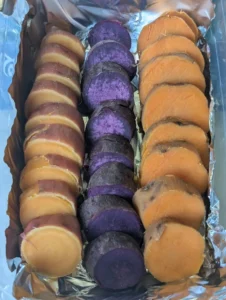
4. Purple-Fleshed Sweet Potatoes
Purple-fleshed sweet potatoes stand out because of their naturally coloured interior. Anthocyanins are responsible for the purple pigmentation, and their concentration differs between varieties. Research has documented substantial variation among purple-fleshed sweet potato genotypes.
Their colour makes them an appealing ingredient for visually distinctive meals. Consider purple sweet potato mash, roasted slices or a colourful dessert.
When developing a recipe, assess flavour and texture alongside appearance. A bright ingredient still needs the right balance of seasoning, moisture and cooking time. For restaurant menus, identify the cultivar or supplier batch so that later deliveries can be compared with the original recipe trial.
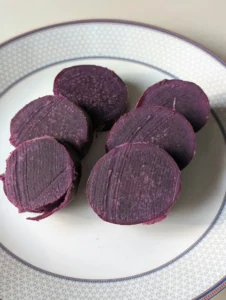
5. Purple-Skinned Sweet Potatoes with Pale Flesh
Purple skin does not necessarily mean purple flesh. Murasaki, for example, has purple skin and light-coloured flesh. Clemson Extension describes its cooked texture as flakier and its flavour as nutty compared with creamier types.
This distinction is useful when shopping from photographs. An attractive purple exterior cannot confirm the interior colour.
Ask to see a cut sample or a reliable product description if flesh colour matters to your recipe. For online listings, photographs of both the whole root and its interior help customers understand what they are buying.
Sweet Potato Varieties Grown in India
Indian sweet potato cultivation includes improved cultivars and locally maintained varieties. ICAR–Central Tuber Crops Research Institute lists varieties including Sree Nandini, Sree Vardhini, Sree Rethna, Sree Bhadra, Sree Arun and Sree Kanaka.
Their characteristics are not interchangeable. Kerala Agricultural University’s variety information describes Sree Rethna as orange-fleshed and early maturing, while Sree Kanaka is a short-duration, carotene-rich cultivar. Sree Nandini is identified as an early-maturing, drought-tolerant option.
These examples show why farmers need more information than a colour preference before selecting planting material.
A variety should be evaluated against local growing conditions, reliable availability of healthy cuttings, expected harvest timing and customer requirements. A successful cultivar in one region should be assessed locally before a farmer commits a large area to it.
Why Are Sweet Potatoes Different?
Genetics Establish the Basic Characteristics
Variety influences skin colour, flesh colour, growth habit and maturity. Even storage-root shape and size vary with cultivar and the soil in which the crop grows.
This explains why two sweet potatoes grown in neighbouring fields can look different.
For buyers, consistency starts with identifying the cultivar. For growers, keeping planting material correctly labelled helps prevent different varieties from becoming mixed. Useful records include the planting-material source, planting date, field location and harvest batch.
Natural Pigments Explain Colour Differences
Orange and purple interiors arise from different pigment groups. Orange-fleshed sweet potatoes are associated with carotenoids, while anthocyanins produce purple pigmentation. A review of sweet potato composition explains these differences across coloured varieties.
Colour is therefore a meaningful characteristic, but it should not become the only purchasing criterion.
A sensible selection considers variety, condition, cooking suitability and handling history together. Avoid assuming that the darkest or brightest root automatically offers the best flavour for every dish.
Postharvest Handling Changes the Eating Experience
Sweet potatoes continue to change after digging. Proper curing can improve eating quality, including perceived sweetness and moistness, while helping wounds heal. Consequently, a freshly harvested root and a properly cured root from the same cultivar may cook differently.
This is particularly relevant when evaluating Farm Fresh Sweet Potato. Freshness should include sound condition and appropriate handling rather than simply the shortest possible time between digging and sale.
Ask whether a batch is newly harvested or cured, especially when planning storage or testing a recipe.
Farming Practices for Quality Sweet Potatoes
1. Choose Healthy Planting Material
Sweet potatoes are commonly propagated using vine cuttings. These cuttings root after planting and produce the next crop; botanical seed is mainly used in breeding programmes.
A practical starting point is to obtain correctly identified planting material from a dependable source.
Farmers should record where cuttings came from and keep batches separate during establishment. If unfamiliar symptoms appear, seek local agricultural advice before multiplying that material further. Starting with a clear record makes later field problems easier to investigate.
2. Select a Well-Drained Field
Field selection strongly influences root quality. Sweet potatoes perform well in well-drained, light soils such as sandy loam. Poor drainage and inadequate soil aeration can contribute to rough, cracked or misshapen roots.
Before planting, inspect the field after rainfall. Notice where water collects, how quickly it drains and whether machinery has compacted particular areas.
These observations help identify sections requiring attention. A field that looks suitable during dry weather may behave very differently during the rainy season.
3. Prepare Soil and Planting Beds
Soil preparation should create a workable root zone while allowing excess water to escape. Tamil Nadu Agricultural University recommends a fine tilth and describes ridge-and-furrow or bed cultivation for sweet potato. Its regional guidance gives a soil pH range of 5.6–6.6.
Treat these figures as regional guidance rather than a universal prescription.
Use a soil test and local recommendations to decide whether amendments are necessary. Bed design should reflect field drainage, soil texture, rainfall and the equipment available for planting and harvesting.
4. Match Nutrition to the Field
Fertiliser decisions should follow soil-test results and locally appropriate crop recommendations. Oklahoma State University emphasises soil testing when planning nutrient applications.
For farm management, record the product, quantity, application date and field treated. This provides a useful basis for comparing performance between seasons.
Avoid copying an entire fertiliser schedule from another farm without checking its soil conditions. Two neighbouring fields can have different nutrient histories, drainage patterns and previous crops. A written plan makes adjustments more deliberate and easier to assess.
5. Manage Irrigation Consistently
Water is especially important during transplant establishment and root development. Clemson Extension also notes that rainfall or irrigation following a prolonged dry period can cause roots to crack.
The practical aim is to monitor the crop and soil rather than follow an unchanged calendar.
Check conditions after rainfall before irrigating again. During dry weather, inspect moisture within the root zone rather than judging only the surface. Keep irrigation records alongside rainfall observations so that future decisions can reflect what actually happened in the field.
6. Control Weeds and Monitor Pests
TNAU recommends keeping the field clean through hand weeding until vines are established. Its sweet potato guidance also identifies sweet potato weevil management measures, including clean planting material, field sanitation and timely harvesting.
Regular inspection should cover several field locations rather than only the most accessible edge.
Record unusual symptoms and their distribution. Photographs with dates can help an agricultural adviser assess whether a problem is spreading. Any crop-protection treatment should follow current local registration, label directions and professional guidance.
The Perfect Climate for Growing Sweet Potatoes
Sweet potatoes need a warm growing season. Indian cultivation guidance describes a warm, humid tropical climate, with a mean temperature of approximately 22°C, and notes that the crop is frost-sensitive. Sunny days and cooler nights can favour storage-root development under suitable conditions.
However, there is no single weather reading that guarantees a successful crop.
Temperature must be considered together with soil moisture, drainage, cultivar and the length of the available growing season. A warm field with persistent waterlogging is unsuitable despite favourable air temperatures.
Farmers should plan backwards from the likely harvest window. Consider whether late-season rainfall could delay digging, whether irrigation is available during establishment, and whether the chosen cultivar can mature before unfavourable weather arrives.
Local experience is valuable here. Compare seasonal records with neighbouring growers and agricultural extension recommendations before finalising planting dates.
Perfect Climate for Sweet Potato Harvesting
The conditions needed for harvesting differ from those needed for active growth. Harvest planning should focus on crop maturity, workable soil and protecting roots from damage.
Choose Workable Soil Conditions
A useful harvest window allows roots to be lifted without excessive digging force or handling. Avoid treating a calendar date as more important than field conditions.
If recent rainfall has left the field saturated, assess drainage and the forecast before proceeding. If the soil is extremely hard, review how digging can be carried out without cutting or bruising roots.
The decision should balance immediate weather risks with the condition of the crop.
Harvest Before Damaging Cold
Clemson Extension recommends harvesting before frost and warns that cool soil can reduce quality and storage capacity. It also stresses gentle digging because sweet potato skins and roots damage easily.
In frost-prone areas, weather forecasts therefore become an important part of harvest scheduling.
In warmer regions, the more pressing concern may be rainfall or field access. The best harvest plan responds to the actual local risk rather than borrowing another region’s seasonal calendar.
Confirm Maturity with Sample Digging
Maturity varies by cultivar. ICAR–CTCRI lists Sree Bhadra at approximately 90 days, while Kerala Agricultural University lists H-41 and H-42 at around 120 days.
Sample digging helps translate those estimates into a field decision.
Inspect roots from several representative locations. Compare their size and condition with the intended market specification. A retailer selling household packs may require a different size range from a processor or restaurant.
Sweet Potato Seasons in India
India does not have one universal sweet potato planting or harvesting season.
Kerala Agricultural University provides different planting windows for rainfed and irrigated production, including June–July and September–October for rainfed crops. These recommendations reflect regional production conditions.
They should not automatically become a planting calendar for every Indian state.
For a farm in West Bengal, decisions should consider local rainfall, land availability, drainage, cultivar duration and the expected market window. Farmers and suppliers can improve coordination by agreeing on likely harvest periods early, then updating those estimates as the crop develops.
Harvesting and Handling Farm Fresh Sweet Potato
Prepare the harvest operation before digging begins. Arrange suitable containers, clear handling areas and a system for separating batches.
Roots should be handled gently throughout lifting, sorting and loading. University of Georgia guidance highlights the importance of curing to strengthen fragile skin and support wound healing after harvest.
For practical quality control, separate visibly damaged roots from sound produce and document any recurring defects.
Keep farm, harvest-date and batch information connected to the produce. This helps suppliers investigate quality concerns and allows repeat customers to request batches with characteristics they previously enjoyed.
Curing, Storage and Transport
Curing is a controlled postharvest process. NC State Extension describes commercial conditions of approximately 29°C and 85–90% relative humidity for three to five days, with ventilation. Other extension guidance recommends roughly a week, so duration depends on the protocol and conditions.
Curing should therefore be managed rather than treated as simply leaving roots outdoors.
After curing, NC State recommends storage around 13°C with appropriate humidity and ventilation. These conditions differ substantially from an ordinary household refrigerator.
For suppliers, storage and transport arrangements should match sweet potato requirements. When buying, ask how the roots were handled and whether they are intended for immediate use or longer keeping.
Choosing a Farm Fresh Vegetable Supplier
A dependable Farm Fresh Vegetable Supplier should help customers understand the product.
Ask about the cultivar where known, flesh colour, source region, harvest timing and curing status. Request a sample when cooking consistency matters.
For shops, clear labels help customers choose confidently. For restaurants, an agreed size range and batch specification can simplify preparation. For households, practical recipe suggestions make unfamiliar varieties easier to try.
When assessing Farm Fresh Sweet Potato, look beyond perfectly matching shapes. Ask whether the roots are sound, appropriately handled and suitable for your intended use. A useful supplier conversation connects the farm’s production choices with the buyer’s actual needs.
Frequently Asked Questions
Which sweet potato is best for roasting?
Start with the texture you prefer. Try a small batch, cut pieces evenly and compare the result. Variety identification helps you repeat a successful purchase.
Does purple skin always mean purple flesh?
No. Murasaki is one example of a purple-skinned sweet potato with a pale interior. Ask for a cut sample when interior colour matters.
How long does sweet potato take to mature?
The period varies by cultivar and conditions. Use the variety’s recommended duration as a starting point, then confirm readiness through field sampling.
Does farm fresh mean harvested that morning?
The phrase alone does not establish a harvest date or handling method. Ask the supplier for specific information, including whether the sweet potatoes have been cured.
Bring the Right Sweet Potato to Your Plate
Sweet potato diversity gives cooks, farmers and buyers plenty to explore. Colour helps distinguish types, while cultivar identity, growing conditions and postharvest handling explain more of the eating experience.
For growers, quality depends on matching the crop to the field and managing it carefully through harvest. For buyers, asking informed questions makes choosing easier.
The next time you purchase Farm Fresh Sweet Potato, consider the dish you want to prepare and ask your Farm Fresh Vegetable Supplier which available variety will suit it best.